Heart rate variability gets talked about a lot in wellness circles. So does meditation. Put them together and you get a topic that attracts both genuine science and a fair amount of overstatement. This article tries to separate the two.
We will cover what HRV actually measures, what research says about meditation's effect on it, and why the distinction between a short-term and a long-term response matters more than most popular summaries let on.
What is HRV, and why does it matter?
Heart rate variability is the variation in time between consecutive heartbeats. If your heart beats at an average of 60 beats per minute, the intervals between those beats are not all exactly one second. They fluctuate, and that fluctuation is HRV.
A higher HRV generally indicates that the autonomic nervous system is more flexible, able to shift between activation and recovery depending on what the body needs. A lower HRV, particularly at rest, tends to reflect a system under sustained load: stress, poor sleep, illness, or accumulated fatigue.
The metric most commonly tracked by consumer wearables is RMSSD, the root mean square of successive differences between heartbeats. It is sensitive to parasympathetic nervous system activity, the branch responsible for rest, digestion, and recovery.
HRV is not a perfect measure. Consumer devices can give different readings from one another, and even a single device can show significant night-to-night variation that is difficult to interpret. It captures a signal, not a full picture. The context of a human life, sleep quality, hydration, emotional load, cycle phase, physical training, all of this shapes the number in ways that no tracker fully accounts for.
That said, when observed over weeks and months rather than single data points, patterns do emerge.
What does meditation actually do to the nervous system?
Meditation encompasses a wide range of practices: focused attention, open monitoring, body scan, breath-based, mantra-based. They do not all produce identical effects, and research has not caught up with the full range of variation. Most studies use standardized protocols, often app-based guided meditation, which may not reflect what experienced practitioners do.
With that caveat in place, what the research does show is consistent enough to be useful.
Meditation activates the parasympathetic nervous system. Slow, controlled breathing, particularly a lengthened exhale, stimulates the vagus nerve, reduces heart rate, and shifts the autonomic balance toward rest and recovery. This is the physiological pathway through which most meditation-related HRV effects are understood to operate: slow the exhale, engage the vagus nerve, the heart reduces its rate, the limbic system becomes less reactive.
The difference between acute and chronic effects
This is the distinction that most popular write-ups miss, and it matters.
Acute effects occur during the session itself. While you are breathing slowly and holding attention, parasympathetic activity increases and HRV rises. This is relatively easy to produce. Even listening to calming music can create a similar short-term shift. The effect is real, but it does not persist once the session ends.
Chronic effects are a different category. They represent a lasting change in baseline HRV, detectable not just during meditation but throughout the day and during sleep, when you are not doing anything in particular. This kind of shift requires regular, sustained practice. It does not come from occasional sessions.
Understanding this distinction changes how you interpret your wearable data. A higher reading on a morning you meditated is not the same thing as a higher baseline that holds across weeks. Both are interesting, but they are measuring different things.
What the research shows
One of the cleaner studies on this question is Kirk and Axelsen, published in PLoS ONE in 2020. The study followed 90 people across three groups: app-based meditation, music listening, and a control group doing neither. The intervention ran for ten days, with sessions of 20 to 30 minutes per day.
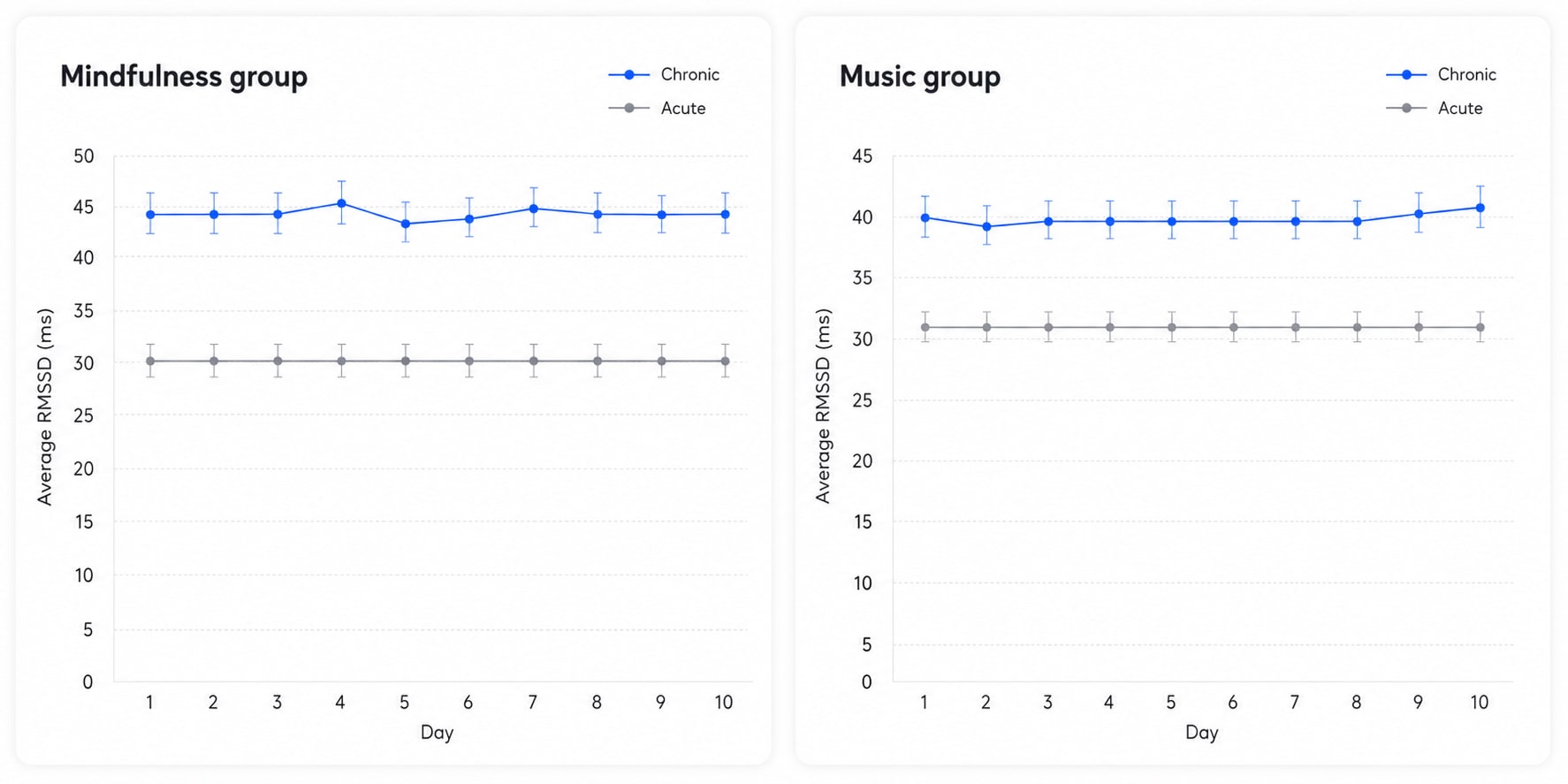
In the meditation group, average RMSSD increased from 30 to 41 ms during the day, and from 36 to 55 ms during sleep. That is a 35 to 50 percent increase over ten days. The music group showed no significant change. The control group's HRV slightly declined.
The study specifically distinguished between acute and chronic effects, which is part of what makes it useful. The chronic shift observed in the meditation group, measurable not just during sessions but across the full 24-hour period, suggests that even a short, consistent practice produces a meaningful change in baseline autonomic function.
Ten days and 90 people is a limited sample. This is one signal in a larger picture, not a definitive proof. But it is clear enough to take seriously.
What the research does not yet tell us
"Meditation is beneficial" is statistically supported. Whether a specific practice will produce a specific effect for a specific person is a different question, and population-level studies cannot answer it.
Several things remain genuinely unclear:
Which protocol produces the largest chronic effect, and whether breath-focused, attention-based, and body scan approaches differ meaningfully in their autonomic outcomes.
How long consistent practice needs to run before a lasting baseline shift becomes detectable and stable.
How individual variation, age, sex, baseline HRV, existing stress load, and prior meditation experience interacts with outcomes.
What the long-term trajectory looks like. Most studies run for days or weeks. Evidence on months and years of practice is much weaker.
This is not a reason to dismiss the research. It is a reason to read it accurately.
HRV as a signal, not a scorecard
One pattern worth naming: the HRV tracking culture that has grown up around wearables can push people toward treating the number as an outcome in itself. Check the reading, adjust the behavior, check again.
The research suggests something more interesting. HRV changes are downstream of nervous system state, not the other way around. You cannot improve HRV directly by trying to improve HRV. What shifts the number is a change in the underlying system: sustained parasympathetic activation, reduced allostatic load, better recovery. Meditation, when practiced consistently, appears to produce that kind of change. The HRV movement follows.
This makes HRV a reasonable signal to observe over time. It makes it a poor target to optimize in isolation.
What this means practically
If you track HRV and are curious whether a meditation practice would move it, the research suggests it can, with consistent daily practice over at least ten days, and likely longer for a stable baseline shift.
If you already meditate and are not seeing movement in your numbers, the acute versus chronic distinction is worth considering. A single morning reading after one session tells you something, but it is not the same as looking at a four-week trend.
And if you find your HRV improving alongside a practice, that signal reflects something real about your nervous system's recovery capacity, not just a number on a screen.
"During periods of consistent meditation, my HRV tends to shift. And yes, it is beautiful to see the body reflecting something that I already know from the inside." — Vera Kozyr, co-founder, Neera
Sources
Kirk, U., and Axelsen, J.L. (2020). Heart rate variability is enhanced during mindfulness practice: A randomized controlled trial involving a 10-day online-based mindfulness intervention. PLoS ONE, 15(12). Read article