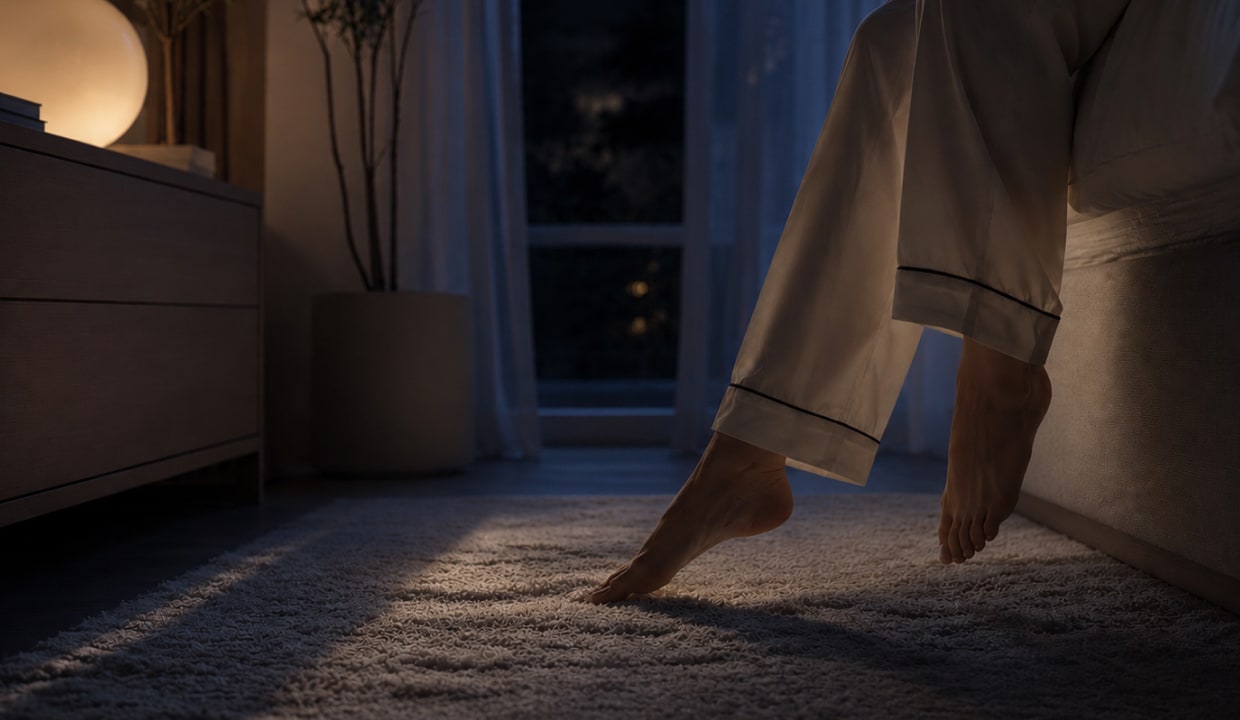
You're wrecked. You've been yawning since 9 p.m., your eyes are gritty, and the second your head hits the pillow your brain flips on like a switch. So why can't you sleep?
Usually it comes down to one of a handful of things: stress and an overactive nervous system, caffeine or alcohol still working through your body, light and screens late at night, an irregular schedule, an uncomfortable bedroom, or an underlying health issue. The reassuring part is that most of these are fixable, and you're in very good company. The CDC found that about 30.5% of U.S. adults slept less than seven hours a night in 2024. Roughly a third of us are running short.
Below are the real reasons you can't sleep, the ones people rarely mention, and a few things you can actually try tonight.
Why can't I sleep even though I'm exhausted?
If you're tired but can't sleep, the usual culprit is something sleep researchers call hyperarousal: your nervous system stays switched on even though your body is begging to shut down. You feel the exhaustion, but the “off” signal never fully lands.
Here's what's happening under the hood. Sleep researchers describe hyperarousal as the core mechanism behind most chronic insomnia, and it shows up in the body as an over-active stress response. People who struggle to sleep tend to have higher evening cortisol and more sympathetic “fight or flight” activity than easy sleepers, according to studies on insomnia and the HPA axis (your central stress-hormone system). Your body is physically tired. Your alarm system just hasn't gotten the memo.
There's even a version of this that gets worse the more exhausted you are. Push past the point of normal tiredness and your body can read the exhaustion itself as a threat, releasing cortisol and adrenaline to keep you going. That's the dreaded second wind, the “too tired to sleep” state that feels so unfair at 1 a.m.
The useful reframe: this isn't you failing at sleep. It's a physiological state, and physiological states can be changed.
What are the most common reasons you can't sleep?
Most sleepless nights trace back to a short list of everyday causes. Here are the ones with the strongest evidence behind them.
Stress and a racing mind
Stress is the classic sleep thief, and it works in two directions. There's the cognitive side, the looping thoughts about work, money, or the conversation you replayed forty times. And there's the physical side, the elevated stress hormones that keep your body primed. When both are running, sleep doesn't stand a chance.
Sleep specialists often describe a three-part path into chronic sleep trouble: you're already somewhat wired by nature, a stressful event tips you over, and then habits like lying in bed frustrated keep it going long after the original stressor is gone. That last part is why a rough week can quietly turn into a rough month.
That afternoon coffee (yes, still)
Caffeine lingers far longer than its buzz. It has a half-life of roughly five to six hours, meaning half of it is still in your system that long after your last sip. In a well-known study by Drake and colleagues published in the Journal of Clinical Sleep Medicine, a 400 mg dose of caffeine taken a full six hours before bed still measurably cut people's total sleep time. The unsettling part is that many of them didn't notice.
So if you're wondering why you can't sleep after a productive day fueled by a 3 p.m. latte, there's your answer. A good rule of thumb is to keep caffeine to the morning and early afternoon.
The nightcap that turns on you
Alcohol is a trap for sleep. It's a sedative, so it genuinely helps you nod off faster, which is exactly why people reach for it. But once your body starts metabolizing it, sleep falls apart. A review from the National Institute on Alcohol Abuse and Alcoholism describes how alcohol suppresses REM sleep early in the night and then fragments the second half, waking you up. A 2024 meta-analysis found REM disruption kicks in at around two drinks and gets worse from there.
This is the mechanism behind a very common complaint: asleep by eleven, wide awake at three.
Screens and light before bed
Evening light, especially the blue-toned light from phones and tablets, tells your brain it's still daytime. That short-wavelength light suppresses melatonin, the hormone that rises in the evening to signal that it's time to sleep, and pushes your internal clock later. A 2025 meta-analysis in Frontiers and an earlier review in SLEEP Advances both found that even short bouts of evening screen use can delay melatonin and stretch out how long it takes to fall asleep.
You don't have to live like a monk. But dimming the lights and putting the phone down an hour before bed genuinely helps.
An irregular schedule
Your body runs on a clock, and it likes consistency. Going to bed at 10 one night and 2 the next, sleeping in on weekends, shift work, jet lag, long naps, all of it scrambles the timing that makes sleep automatic. A predictable bedtime and, more importantly, a predictable wake time are two of the most powerful sleep tools you have, and they're free.
Are there surprising reasons I can't sleep?
Yes, and some are genuinely easy to miss. Johns Hopkins Medicine points to a handful of sneaky ones: a hot shower right before bed (it raises your core temperature when it should be dropping), exercising too close to bedtime, pets in the bed tracking in allergens and moving around, and spicy food that triggers reflux once you lie down.
Then there are the medical causes worth taking seriously. Sleep apnea, where breathing briefly stops during the night, overlaps heavily with insomnia. Draft materials from the American Academy of Sleep Medicine note that roughly 30% of people with chronic insomnia also have obstructive sleep apnea. Restless legs syndrome, chronic pain, acid reflux, certain medications, and hormonal shifts like pregnancy and menopause can all keep you up too. If you snore loudly, wake up gasping, or feel exhausted no matter how long you're in bed, those are worth a conversation with a doctor.
Why do I keep waking up at 3 a.m.?
Waking in the middle of the night is often a different problem than struggling to fall asleep, and it has its own usual suspects: alcohol wearing off, a full bladder, pain, sleep apnea, or an anxious mind that spins up the moment you surface. Trouble staying asleep also becomes more common with age. CDC data from 2024 shows it climbing from about 12.7% of adults aged 18 to 34 to 22.3% of those aged 50 to 64.
If you had a drink with dinner, that 3 a.m. wake-up is textbook. The alcohol that eased you to sleep has now been metabolized, and your body rebounds into lighter, more broken sleep for the rest of the night.
What can I do right now when I can't sleep?
If you've been lying awake for about 20 minutes, get out of bed. It sounds backwards, but it's one of the most effective things you can do. As sleep specialist Shelby Harris, PsyD, explains via the JED Foundation, the longer you lie there tossing and turning, the more you train your brain to associate the bed with being awake. Go to another room, keep the lights low, do something quiet and a little boring, and come back only when you feel genuinely drowsy.
A few more things that help in the moment:
- Don't watch the clock. Doing the “if I fall asleep now I'll get five hours” math just cranks up the pressure. Turn it away from you.
- Slow your breathing. Techniques like 4-7-8 breathing or belly breathing nudge your nervous system out of alert mode. The Sleep Foundation lists these among simple, evidence-backed ways to wind down.
- Get the light right. Cool, dark, and quiet wins. Somewhere around 60 to 67°F suits most people, though it's worth experimenting to find your own comfortable range.
- Let go of the perfect-night goal. One bad night won't wreck you. Ironically, the less you panic about it, the easier sleep comes.
When does trouble sleeping become insomnia?
Occasional bad nights are normal; it's insomnia when the trouble is frequent and lasting. The clinical line, per the American Academy of Sleep Medicine, is difficulty sleeping at least three nights a week for at least three months, with real effects on your daytime life. About 10% of adults have chronic insomnia at that level, while roughly 35% deal with insomnia symptoms at some point in a given year.
Here's the part worth knowing: the recommended first-line treatment for chronic insomnia isn't a pill. It's CBT-I, cognitive behavioral therapy for insomnia, a structured, short-term approach that retrains the thoughts and habits keeping you awake. The American College of Physicians recommends it as the starting point for everyone with chronic insomnia, and it tends to outlast medication because it fixes the underlying pattern rather than masking it.
When should I see a doctor about not sleeping?
See a doctor if your sleeplessness is frequent, has dragged on for months, or is dragging down your days. That's not overreacting; sleep is foundational. As Michael Grandner, who directs the Sleep and Health Research Program at the University of Arizona, put it, our need for sleep is as basic as our need for air and water.
It's also worth knowing that sleep and mental health are tightly linked. The American Academy of Sleep Medicine's clinical guideline notes that around 40% of people with insomnia have a co-occurring psychiatric condition like anxiety or depression, and the relationship runs both ways: poor sleep feeds low mood, and low mood feeds poor sleep. A doctor can help untangle which is driving which. And if you're struggling and need to talk to someone right now, you can reach the 988 Suicide and Crisis Lifeline in the U.S. by calling or texting 988.
FAQ
Why am I so tired but can't sleep at night?
Being tired but unable to sleep usually points to hyperarousal: your nervous system stays activated despite physical exhaustion. Elevated evening cortisol and a revved-up stress response keep your brain alert even when your body is drained. Winding down slowly and getting out of bed if you're wired can help.
Why can't I sleep after drinking alcohol?
Alcohol helps you fall asleep but wrecks the rest of the night. It suppresses REM sleep early on, then fragments your sleep in the second half as it's metabolized, according to research from the National Institute on Alcohol Abuse and Alcoholism. That rebound is why a nightcap so often leads to a 3 a.m. wake-up.
Why can't I sleep through the night?
Waking repeatedly usually comes from alcohol wearing off, a full bladder, pain, sleep apnea, or an anxious mind. It also increases with age; CDC data shows more than 1 in 5 adults aged 50 to 64 have trouble staying asleep. If it happens most nights or you wake gasping, see a doctor to rule out apnea.
How long should it take to fall asleep?
Falling asleep isn't instant, and that's normal. The more useful rule is what to do when it isn't happening: if you've been lying awake for roughly 20 minutes, don't keep trying. Get up, do something calm in dim light, and return to bed when you feel sleepy, so your brain keeps linking the bed with sleep rather than frustration.
If tonight is rough, start with the two changes that move the needle most: cut caffeine after lunch, and hold a steady wake-up time even after a bad night. Do those consistently for a couple of weeks before you judge anything else. And if the sleepless nights keep stacking up, that's your cue to bring it to a doctor rather than tough it out alone.