Sleep is important because it's when your body and brain do essential maintenance work that can't happen while you're awake: consolidating memories, clearing metabolic waste from the brain, producing immune cells, and repairing tissue. It isn't idle downtime. According to the National Heart, Lung, and Blood Institute, your body is actively working during sleep to support healthy brain function and maintain physical health, and in children and teens it also drives growth and development.
That's why losing sleep doesn't just make you tired. It measurably affects how well you think, remember, fight off infection, regulate your mood, and process glucose. Here's what actually happens while you're asleep, why each piece matters, and what the evidence says goes wrong when you don't get enough.
What actually happens while you sleep?
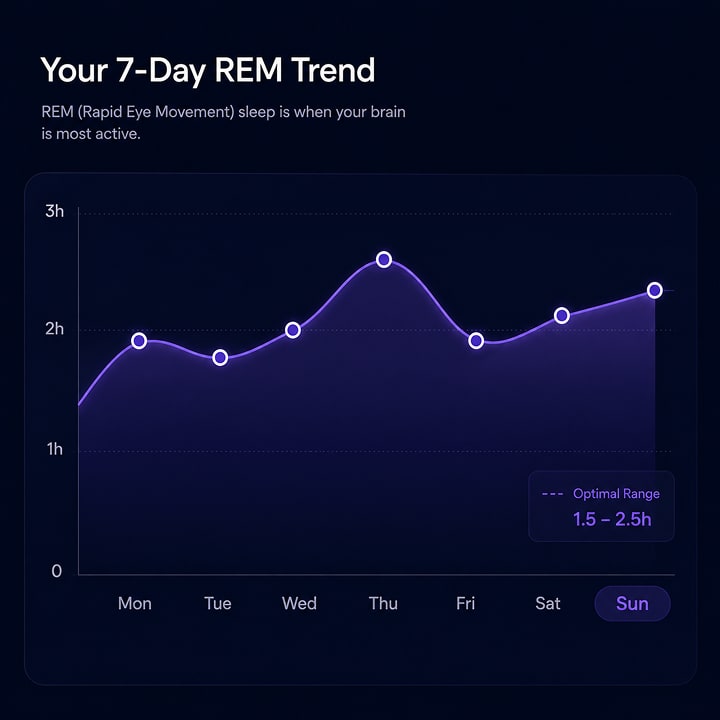
Far from shutting down, your brain runs a busy overnight schedule, and the work is split between the two main types of sleep. Non-REM sleep, especially the deep slow-wave stage, handles physical repair and immune function. REM sleep handles memory consolidation, learning, and emotional processing. You cycle through both several times a night, which is why cutting sleep short doesn't just remove “some sleep,” it disproportionately removes whichever stages come later.
Three processes are worth understanding in particular.
- Your brain takes out the trash. During sleep, the brain's glymphatic system uses cerebrospinal fluid to flush metabolic waste out of the central nervous system, including proteins like beta-amyloid and tau. Researchers at the University of Rochester, whose team first identified this system in 2012, describe brain cells subtly shrinking during sleep to open up space for fluid to flow through more freely. The clearance is most active during deep non-REM sleep. Worth noting: this was discovered in animal research and the human evidence is still developing, so treat it as strong emerging science rather than a settled account, and be skeptical of anyone claiming sleep straightforwardly prevents dementia.
- Your sleep drive resets. While you're awake, a compound called adenosine accumulates in the brain and creates the growing pressure to sleep. Sleep clears it out, which is a large part of why you wake up feeling alert. Caffeine, incidentally, works by blocking adenosine's action rather than removing it.
- Your immune system gets to work. During sleep your body produces cytokines, antibodies, and immune cells that fight infection and inflammation. The NHLBI notes that certain immune cells work harder while you sleep, which is one reason people who don't sleep enough are more prone to colds and other infections.
Sleep and your brain: memory, learning, and focus
Sleep is essential for turning new experiences into lasting memories. Sleep helps with learning and the formation of long-term memories, according to the NHLBI, and not getting enough of it, or enough good-quality sleep, makes it harder to focus and think clearly.
Harvard's sleep researchers describe two distinct routes by which sleep supports learning. First, attention: a sleep-deprived person can't focus well enough to absorb information efficiently in the first place. Second, consolidation: sleep itself stabilizes and strengthens newly formed memories. Sleep also appears to help the brain discard information it doesn't need, which prevents useful memories from being buried in clutter.
The flip side is measurable. Chronic sleep deprivation produces deficits in executive function such as planning, makes learning new information harder, and causes a decline in working memory. If you've ever pulled an all-nighter to study and retained almost nothing, that's both mechanisms failing at once.
Sleep and mental health
Sleep and emotional wellbeing are tightly linked, and the connection runs in both directions. During sleep, activity increases in the brain regions that regulate emotion, which supports emotional stability, and REM sleep in particular is when much of your emotional processing happens.
When sleep is chronically short, the mental health consequences show up clearly: chronic sleep deprivation is associated with both anxiety and depression. Because the relationship is bidirectional, poor sleep can worsen mood and mood disorders can wreck sleep, which is why addressing sleep is often part of treating them. If you're struggling to sleep because your mind won't switch off, our guide on why you can't sleep looks at the causes in detail.
Sleep and your physical health
The physical effects are where the evidence is most concrete.
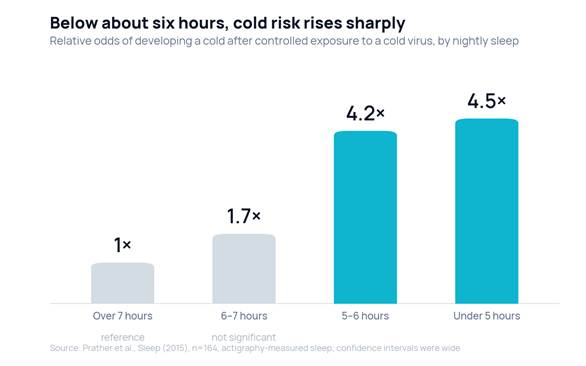
Infection resistance. The most striking demonstration comes from a study published in the journal Sleep in 2015, in which researchers tracked 164 healthy adults' sleep for a week using wrist monitors and then deliberately exposed them to a cold virus. Compared with people who slept more than seven hours, those sleeping under five hours were about 4.5 times more likely to develop a cold, and those sleeping five to six hours were about 4.2 times more likely. The effect held after accounting for pre-existing antibodies, age, season, body mass, stress, and health habits. Notably, the six-to-seven-hour group showed no statistically significant increase, so the sharp risk rise appears below roughly six hours.
Vaccine response. A 2023 meta-analysis in Current Biology found that objectively measured short sleep (under six hours) in the days around vaccination was associated with a substantially weaker antibody response. Sleeping properly around a vaccination appointment appears to matter for how much protection you get.
Heart and metabolic health. Poor sleep is linked to heart disease, and researchers believe sleep supports cardiovascular health, although the mechanism isn't fully mapped. Metabolically, your brain uses less glucose during sleep, which helps with overall blood-sugar regulation, and chronic short sleep is associated with obesity in both adults and children as well as diabetes and impaired glucose tolerance.
Safety. Insufficient sleep is linked to car crashes, industrial accidents, and medical errors, which is why the CDC has treated it as a public health issue rather than a personal inconvenience.
What happens if you don't get enough sleep?
The most common misconception about sleep loss is that daytime sleepiness is the only consequence. It isn't. Chronic sleep deprivation, generally defined as regularly getting under seven hours a night, is associated with impaired memory, impaired immune function, obesity in adults and children, diabetes and impaired glucose tolerance, cardiovascular disease and high blood pressure, anxiety, depression, and a higher rate of accidents.
None of this means one bad night will harm you. The concern is a sustained pattern, and the reassuring corollary is that the effects of short-term sleep loss largely reverse once you're sleeping adequately again.
Why sleep matters even more at certain ages
Sleep needs shift across life, and its role changes too. In children and teens, sleep does developmental work that it no longer needs to do in adults: it supports physical growth and brain development, which is a large part of why teenagers need more sleep than their parents, precisely when school schedules and social lives conspire against it.
One myth worth correcting concerns aging. Many people assume they need more sleep as they get older, but according to Johns Hopkins Medicine, adults' sleep requirements stay fairly stable throughout adulthood. If your sleep need seems to have changed substantially, that's worth investigating rather than attributing to age.
How much sleep do you actually need?
Most adults need seven to nine hours of sleep a night, with the CDC advising at least seven. Children and teens need more: teenagers should get eight to ten hours, school-age children nine to eleven, and newborns as much as fourteen to seventeen. Adults over 65 sit slightly lower, at around seven to eight hours.
Quantity is only half the equation, though. Fragmented, low-quality sleep can leave you unrested even at eight hours, because the restorative processes above need consolidated sleep to run properly. Our guides on improving sleep quality and sleeping better at night cover how to get both the hours and the quality. And if you nap, the CDC suggests keeping naps to around 20 minutes, which reduces fatigue without leaving you groggy.
Frequently asked questions
Why is sleep important for mental health?
Sleep regulates emotion. Activity in the brain's emotion-regulating regions increases during sleep, and REM sleep is when much of your emotional processing occurs, so short sleep leaves you more reactive and less resilient. Chronic sleep deprivation is associated with both anxiety and depression, and because the relationship runs both ways, improving sleep is often part of improving mental health.
Why is sleep important for teens and students?
Sleep drives growth and brain development in adolescents, and it's central to learning. It supports the attention needed to absorb material and the consolidation that turns studying into durable memory, which is why teenagers need eight to ten hours and why all-night cramming tends to backfire.
Why is sleep important for weight loss?
Chronic short sleep is associated with obesity in both adults and children, along with impaired glucose tolerance and a higher risk of type 2 diabetes. Sleep also affects how your body regulates blood sugar, since the brain uses less glucose while you sleep. Adequate sleep won't cause weight loss on its own, but persistent sleep deprivation works against metabolic health.
Which is more important, REM or deep sleep?
Both, because they do different jobs. Deep non-REM sleep handles physical repair, immune function, and the brain's waste clearance, while REM sleep handles memory consolidation and emotional processing. You need enough total sleep for adequate amounts of each, and our guides on deep sleep and REM sleep explain how each stage works.
The reason sleep is important comes down to this: it's the only time your body runs certain essential processes, from consolidating what you learned to clearing your brain's metabolic waste to building the immune cells that fight infection. Treating it as expendable time means skipping maintenance your body can't do any other way. Getting seven to nine consolidated hours is one of the highest-return things you can do for both your brain and your body.