Sleep affects mental health in both directions at once: poor sleep measurably impairs your ability to regulate emotions, and mental health conditions in turn disrupt sleep, each feeding the other. That two-way loop is the single most important thing to understand about this relationship, because it explains why sleep problems and mood problems so rarely travel alone.
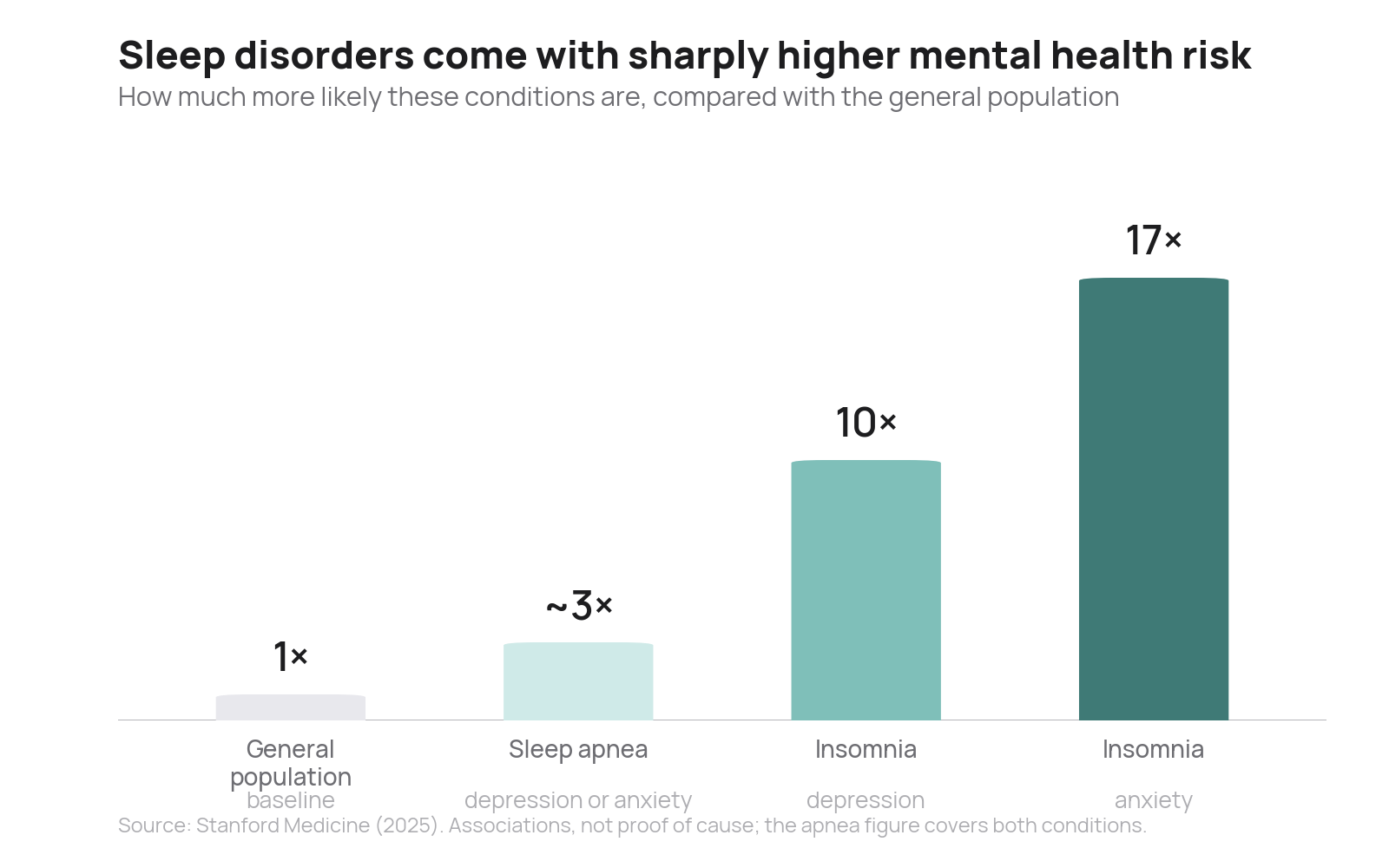
The numbers are striking. According to Stanford Medicine, people with insomnia are roughly 10 times more likely to have depression and 17 times more likely to have anxiety than the general population, and sleep apnea raises the risk of these conditions about threefold. Sleep disturbances are present in around 90% of people with clinical depression.
The encouraging part, and the reason this is worth understanding rather than just worrying about, is that the loop runs both ways. Sleep is one of the more modifiable factors in mental health, and treating sleep problems directly has been shown to improve depression, anxiety, and PTSD symptoms.
What happens to your brain when you don't sleep
Sleep loss impairs emotional regulation by weakening the brain's braking system. The clearest account comes from research led by Matthew Walker's group at Berkeley.
In their work, participants who were sleep-deprived showed amplified amygdala responses to negative emotional images compared with rested controls, both in intensity and in the extent of activation. The amygdala is central to emotional reactivity. What made the finding compelling was the second half: with normal sleep, the prefrontal cortex maintained strong connectivity with the amygdala, exerting inhibitory top-down control. Without sleep, that connectivity dropped, apparently removing the brake and leaving an overactive emotional response. They named the paper accordingly, describing the sleepless emotional brain as a prefrontal-amygdala disconnect.
One nuance most articles skip, and it matters: a later fMRI study looked at sleep restriction rather than total deprivation, the milder version most of us actually experience. It found the behavioral effect, impaired emotional regulation, but detected no corresponding brain activation changes, and its authors concluded their data did not support a prefrontal-amygdala disconnect after sleep restriction. So the behavioral finding holds up well, while the specific mechanism is well supported for total sleep deprivation and less settled for the ordinary short nights most people have.
Two further findings sharpen the picture:
- It's not simply that you become sad. Sleep deprivation also amplifies reactivity in the brain's reward networks, biasing how you appraise positive experiences. The net effect is a shift toward emotional extremes in both directions, with less nuance in between. That matches the lived experience of being overtired: small irritations feel enormous, and so does a minor bit of good news.
- Tired brains lean negative. Alongside those extremes, research indicates a bias toward detecting and responding to negative information.
REM sleep as overnight therapy
There's a more hopeful mechanism running in the other direction. Sleep doesn't just fail to protect your emotions when it's absent; when present, it appears to actively process them.
Walker and van der Helm proposed what they called an overnight therapy function for REM sleep. The idea is that REM sleep decouples emotion from memory: you keep the memory of a difficult event, but recall stops carrying the same visceral, autonomic charge. They suggested this reprocessing may help prevent a state of chronic anxiety.
The supporting observations are neat. After a night of undisturbed sleep, both subjective emotional reactivity and amygdala reactivity to previously-seen emotional images decreased, while connectivity between the amygdala and ventromedial prefrontal cortex increased. Across a day of wakefulness, by contrast, amygdala reactivity to the same images increased. Related work found that a night of sleep restores amygdala-prefrontal connectivity, and that how much it recovers is predicted by the physiological quality of the preceding REM sleep. If you want the fuller picture of that sleep stage, our guide on how much REM sleep you need covers it in more depth.
Sleep and depression
Sleep problems and depression are so intertwined that sleep disturbance was long treated as merely a symptom of depression. That view has changed.
The prevalence tells part of the story: sleep disturbances are present in roughly 90% of people with clinical depression, and Stanford Medicine puts the depression risk for people with insomnia at about 10 times that of the general population. But the more consequential finding is about sequence. A meta-analysis of longitudinal studies found that insomnia symptoms predict the later onset of depressive symptoms. Insomnia isn't only a consequence of depression; it's a risk factor for developing it.
Running the other way, depression disrupts sleep in characteristic patterns, including early-morning awakenings, fragmented sleep, and changes to the circadian processes that regulate sleep timing. For some people those disturbances become entrenched and progress into full insomnia, which then feeds back into mood. That's the loop in practice: poor sleep produces fatigue, irritability, blunted positive emotion, and cognitive difficulty, all of which deepen depression, which further degrades sleep.
Sleep and anxiety
The anxiety link is, if anything, tighter. Stanford Medicine reports that people with insomnia are about 17 times more likely to have anxiety than the general population.
Anxiety and sleep interfere with each other mechanically. An anxious mind is a physiologically aroused mind, and arousal is the direct opposite of the state sleep requires, which is why worry at bedtime is so effective at preventing sleep. Then the sleep loss degrades emotional regulation, which lowers the threshold for the next day's anxiety.
The relationship is recognized clinically. In the DSM-5, sleep disturbance is one of the diagnostic criteria for generalized anxiety disorder, and generalized anxiety disorder is the most common psychiatric diagnosis among people with insomnia. Symptom-level network analyses of insomnia patients consistently find significant bidirectional relationships between insomnia, anxiety, and depressive symptoms rather than a one-way street.
One bad night versus chronic sleep loss
It's worth separating the two, because they're different problems.
A single bad night makes you more emotionally reactive, less able to regulate, and more prone to negative interpretation the next day. It's unpleasant and it can genuinely affect how you handle a difficult conversation, but it's temporary and it resolves with normal sleep.
Chronic sleep loss is the one associated with the risk figures above. Sustained poor sleep is where the loop establishes itself, where insomnia begins predicting rather than merely accompanying mood disorders, and where the relationship becomes self-reinforcing. The practical implication: don't over-read one rough night, and don't under-read a pattern that's lasted months.
Can improving your sleep improve your mental health?
Yes, and this is the most useful finding in the entire field. Because the relationship is bidirectional, sleep is a lever you can actually pull.
The evidence centers on cognitive behavioral therapy for insomnia, or CBT-I, the first-line treatment for chronic insomnia. It's a structured, non-drug program combining cognitive restructuring, sleep restriction, stimulus control, sleep hygiene education, and relaxation techniques.
What makes it relevant here is that its benefits extend past sleep. CBT-I has been shown to improve depression, anxiety, and PTSD symptoms, as well as suicidal ideation. A systematic review found CBT-I a promising treatment for depression occurring alongside insomnia, and for anxiety it has demonstrated moderate to large effect sizes on generalized anxiety disorder symptoms. Perhaps most telling, findings suggest that the improvement in insomnia may mediate the reduction in depressive symptoms, meaning the sleep improvement appears to be part of how the mood improvement happens, not a coincidence alongside it.
CBT-I is also increasingly accessible. Digital and internet-delivered versions have been evaluated in systematic reviews, and brief formats have shown benefit, which matters given how few clinicians are trained to deliver the full program.
A caution worth knowing: medication decisions in this space genuinely need a clinician. Some hypnotics can worsen mood, and some antidepressants can aggravate sleep disturbance, so this is not territory for self-experimentation.
Alongside formal treatment, the fundamentals still matter: a consistent wake time, morning light, limiting alcohol and late caffeine, and a wind-down routine. Our guides on improving sleep quality and sleeping better at night cover those in detail.
When to get help
If poor sleep has persisted at least three nights a week for three months or more, that meets the usual threshold for chronic insomnia and is worth taking to a doctor. The same is true if sleep problems are accompanied by persistent low mood, loss of interest in things you normally enjoy, or worry you can't switch off.
The reason to raise both together is practical: because they interact, treating one often helps the other, and a clinician can address the combination rather than either half in isolation. Given how strongly sleep apnea is linked to depression and anxiety, loud snoring, gasping in your sleep, or waking unrefreshed despite adequate hours is also worth evaluating.
One more thing, stated plainly because it matters. Persistent sleep problems are associated with an increased risk of suicidal thoughts, and this is a reason to seek help sooner rather than later, not a reason to despair, since treatment is genuinely effective and CBT-I in particular has been shown to reduce suicidal ideation. If you're having thoughts of harming yourself, please reach out now rather than waiting: in the US you can call or text 988 to reach the Suicide & Crisis Lifeline, which is free and available 24/7. If you're elsewhere, your local crisis line or emergency services can help.
Frequently asked questions
Can lack of sleep cause depression?
Sleep loss doesn't cause depression on its own, but it's a genuine risk factor rather than only a symptom. A meta-analysis of longitudinal studies found insomnia symptoms predict the later onset of depressive symptoms, and Stanford Medicine reports people with insomnia are around 10 times more likely to have depression. The relationship runs both ways, which is why treating sleep can improve mood.
How does sleep deprivation affect emotions?
It weakens emotional regulation. Research found that after sleep deprivation, the amygdala responded more strongly to negative images while its connectivity with the prefrontal cortex, which normally exerts calming top-down control, decreased. Sleep loss also amplifies reward-network reactivity, so responses swing toward extremes in both directions with less nuance.
Does anxiety cause insomnia, or does insomnia cause anxiety?
Both, which is the point. Anxiety produces the physiological arousal that prevents sleep, while sleep loss degrades the emotional regulation that keeps anxiety manageable. Sleep disturbance is a DSM-5 diagnostic criterion for generalized anxiety disorder, and network analyses of insomnia patients consistently show bidirectional relationships rather than one direction of causation.
Will fixing my sleep fix my mental health?
It can meaningfully help, though it isn't a cure on its own. CBT-I improves depression, anxiety, and PTSD symptoms alongside sleep, and evidence suggests the sleep improvement partly mediates the mood improvement. Treat better sleep as a powerful component of mental health care rather than a replacement for it, and work with a clinician if symptoms are significant.
How much sleep do I need for good mental health?
Most adults need seven to nine hours, and consistency matters as much as duration since irregular timing disrupts the circadian rhythm that supports mood. Quality counts too: fragmented sleep can leave you unrested at eight hours, and REM sleep in particular appears important for processing emotional experience.
The core insight is that sleep and mental health aren't separate problems that happen to co-occur, they're a single system with feedback running in both directions. That's daunting when the loop is turning against you, and genuinely encouraging otherwise, because it means improving one side tends to lift the other. If you're struggling with both, that's not two battles; it's one, and it's worth getting proper help with rather than fighting alone.