A sleep-tracking wearable is a device you wear overnight, usually a ring, watch, or band, that uses motion and heart-rate sensors to estimate how long and how well you slept. The important word is estimate. These devices don't measure sleep the way a sleep lab does; they infer it from your body's signals, which is why they're genuinely useful for spotting trends and genuinely unreliable for judging any single night.
Understanding that distinction is the difference between a tracker that helps you and one that quietly makes you anxious. Below is how the technology actually works, what the validation research says about its accuracy, what a tracker can realistically do for you, and an honest look at five of the most popular devices, including what each one gets wrong.
How do sleep-tracking wearables work?
Sleep trackers combine two sensors: an accelerometer that detects movement and a PPG sensor that reads your pulse through your skin. Together these produce estimates of when you fell asleep, when you woke, and which sleep stage you were in.
Movement came first. Sleep researchers have used actigraphy since the 1990s: a wrist-worn device with an accelerometer that assumes you're awake when you're moving and asleep when you're still. It works reasonably well, but it has an obvious flaw, as sleep scientists point out: lying still while awake, reading in bed for instance, can get logged as sleep.
Then came the pulse sensor. The bigger leap was photoplethysmography, or PPG. Those little green lights on the underside of your watch or ring shine into your skin, and a photodetector measures how much light comes back, which reveals the changing volume of blood beneath. It's the same principle as the clip-on pulse oximeter a doctor puts on your finger. From that signal, the device derives your heart rate, heart rate variability, breathing rate, and often blood oxygen.
That's how stages get estimated. Each sleep stage leaves a distinct fingerprint on your cardiovascular system, so algorithms can use heart rate and HRV patterns, plus movement, to guess whether you were in light, deep, or REM sleep. Many devices add skin temperature and SpO2 sensors on top.
Here's the crucial limitation. A clinical sleep study, polysomnography, stages sleep by recording brain waves, eye movements, and muscle tone. Your ring cannot read your brain activity. It's inferring what your brain is doing from what your heart and body are doing, which is a clever approximation rather than a measurement.
How accurate are sleep trackers?
Sleep trackers are quite accurate at total sleep time and considerably less accurate at everything else. Research comparing wearables against polysomnography finds they correctly identify over 90% of sleep periods, typically landing within about 20 to 30 minutes of the lab's total sleep time.
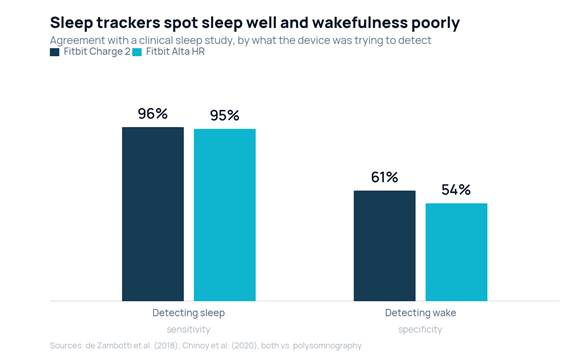
The weak spot is detecting when you're awake. In a validation study of the Fitbit Charge 2, the device showed 96% sensitivity, meaning it was excellent at recognizing sleep, but only 61% specificity, meaning it was poor at recognizing wakefulness. A study of the Fitbit Alta HR found a similar split, at 95% sensitivity and 54% specificity. The pattern holds across the category: if you're lying still, your tracker tends to call it sleep. That's also why brief awakenings of one to five minutes are frequently missed, since the heart-rate changes lag behind what the brain is doing.
Sleep stages are the least reliable numbers on the screen. Devices differ meaningfully here: a 2024 study from Brigham and Women's Hospital comparing several wearables found the Oura Ring classified four-stage sleep about 5% more accurately than the Apple Watch and about 10% more accurately than the Fitbit Sense, after adjusting for chance. Other devices have measurable biases. A laboratory study comparing multisport watches against polysomnography found Garmin overestimated total sleep time by an average of roughly 85 minutes, and both Garmin and Polar overestimated light sleep while underestimating deep sleep.
Two more caveats worth knowing. The American Academy of Sleep Medicine notes that not every device on the market has published validation studies, and it's worth checking what population and which outputs a device was actually validated for. And because manufacturers update their algorithms through firmware, a device's accuracy can shift over time, for better or worse.
The honest summary: there is no single “most accurate” sleep tracker, because different devices win on different metrics. Treat total sleep time as roughly trustworthy, treat wake time as understated, and treat stage percentages as a rough trend rather than a measurement.
How can a sleep tracker actually help you?
Used properly, a tracker is a pattern-finding tool rather than a verdict machine. Here's where the real value lies.
- Trends over weeks, not single nights. One bad score means very little; a month of data showing your sleep shortening or fragmenting means a lot. Sleep experts consistently advise against reading too much into any individual night.
- Connecting habits to outcomes. This is the genuinely useful part. Because the tracker logs every night, you can see what alcohol, a late meal, afternoon caffeine, a stressful day, a hard workout, or a warm bedroom actually does to your sleep. That feedback loop is hard to replicate any other way.
- Noticing what you'd otherwise miss. Bedtime drift and chronic short sleep are easy to under-estimate from memory. Seeing your real average is often the nudge that changes behavior.
- Recovery guidance. Some devices combine sleep with HRV and activity to produce readiness or recovery scores, like Garmin's Body Battery, which can help you decide when to push and when to rest.
- Early warning signs. SpO2 sensors can reveal dips in overnight blood oxygen that may be associated with sleep apnea. Samsung received FDA approval for a sleep apnea analysis feature, and Apple followed with the Series 9 and later, including all Ultra models. These are screening and notification features, not diagnoses, but they've prompted plenty of people to get properly evaluated.
- Gentler wake-ups. Features like Garmin's Smart Wake vibrate when the device thinks you're in lighter sleep within a set window, which can reduce that groggy, dragged-out-of-deep-sleep feeling.
One caution. Fixating on your scores can genuinely backfire, a phenomenon sometimes called orthosomnia, where anxiety about sleep data starts to disrupt sleep itself. If checking your score each morning makes you tense, that's a signal to look at the weekly trend and stop reading the nightly number.
The 5 best sleep-tracking wearables
Prices and lineups change quickly in this category. The details below were verified in July 2026; treat the figures as approximate and check current listings before buying.
1. Oura Ring 4, best for sleep tracking specifically
The Oura Ring is the device most reviewers and validation studies point to when sleep itself is the priority. It's a ring weighing only a few grams, which makes it the easiest of these to actually wear every night, and it tracks sleep stages, readiness and recovery, HRV, skin temperature trends, and blood oxygen. It also performed best of the compared devices in that Brigham and Women's four-stage classification study.
- Pros: Best-in-class sleep staging among mainstream wearables; extremely comfortable overnight; sleep-focused app; temperature trends are a nice extra.
- Cons: Requires a subscription for full features on top of the hardware (around $349 at the time of writing); no screen; no on-device workout tracking, so many people end up wearing a watch during the day as well.
2. WHOOP 5.0, best for athletes and recovery
WHOOP takes a different approach: a screenless band sold on a subscription model, built around tying your sleep data directly to recovery and strain scores. If your training decisions are what you want sleep data for, nothing else connects those dots as directly.
- Pros: The strongest link between sleep data and actionable recovery guidance; comfortable screenless band; strong for athletes and anyone doing structured training.
- Cons: Subscription-based, so there's an ongoing cost; no display, so it's useless as a watch; genuinely overkill if you just want to know how long you slept.
3. Apple Watch Series 11, best if you already have an iPhone
For iPhone users who'd rather not buy a dedicated sleep device, the Apple Watch has become a legitimately good option. It offers a native Sleep Score and the Vitals feature, and reviewers note its sleep-versus-wake reporting is as accurate as Oura's, even though its stage classification trails. It also carries FDA-cleared sleep apnea notifications on the Series 9 and later, including all Ultra models.
- Pros: No extra device needed; sleep/wake detection is genuinely strong; sleep apnea notifications are a meaningful health feature; one device for fitness, notifications, and sleep.
- Cons: Stage classification is behind Oura in validation; battery life means you need a deliberate charging routine to wear it overnight; iPhone-only.
4. Fitbit Charge 6, best value
The Charge 6 delivers most of what people actually want from a sleep tracker for a fraction of the price, typically around $99 to $140 and often discounted. It tracks sleep stages, a sleep score, SpO2, skin temperature variation, respiratory rate, and resting heart rate, and Fitbit Premium is optional at $9.99 a month rather than required.
- Pros: By far the best price-to-capability ratio here; slim and comfortable; no mandatory subscription; covers all the core metrics.
- Cons: Stage agreement with lab measurement is only moderate, behind Oura and Apple; some of the more detailed insights sit behind the Premium paywall.
5. Garmin, best for battery life and existing Garmin users
Garmin covers this from two directions. The Venu 3 and similar watches offer excellent battery life alongside sleep tracking, which removes the nightly charging problem. Alternatively the Garmin Index Sleep Monitor is a dedicated sleep armband at $169.99, notable for having no subscription at all, with every feature included in the purchase. Reviewers testing it found its data matched the Oura Ring 4 and the Withings Sleep Analyzer and lined up with their own sleep diaries, and it feeds Garmin's Body Battery and Smart Wake alarm.
- Pros: No subscription; excellent battery life on the watches; Body Battery recovery insight is genuinely useful; the Index Monitor is comfortable and accurate in testing.
- Cons: Validation research has found Garmin devices overestimating total sleep time significantly and misallocating light versus deep sleep; the Garmin Connect app is data-dense and not beginner-friendly; the Index Monitor is expensive for a sleep-only device; larger watches like the Fenix 8, which starts around $999, are bulky to sleep in.
Quick comparison
Also worth a look: Samsung's Galaxy Watch has FDA-approved sleep apnea analysis, the Google Pixel Watch 4 tracks sleep well within Android, and if you'd rather not wear anything at all, the Withings Sleep Analyzer sits under your mattress instead.
How to choose one
Start with what you'll actually wear. The most accurate tracker is worthless if it's uncomfortable or dead at bedtime, so the ring-versus-watch question usually matters more than a few percentage points of staging accuracy. Then decide whether you want sleep data alone (Oura or the Garmin Index Monitor), sleep plus everything else (Apple Watch or a Garmin watch), or sleep tied to training decisions (WHOOP). Finally, check the total cost including any subscription, since a cheaper device with no subscription can easily beat a pricier one over two years. If you mainly want to know whether you're sleeping enough and how your habits affect it, the budget option will serve you as well as the premium one.
When to see a doctor instead of buying a tracker
No consumer wearable can diagnose a sleep disorder, and this is the most important caveat in this article. If you snore loudly, gasp or stop breathing in your sleep, feel exhausted no matter how long you were in bed, or have struggled to fall or stay asleep at least three nights a week for three months or more, the right next step is a doctor, not a better tracker.
That's especially true if your tracker data looks alarming. A wearable flagging low oxygen or fragmented sleep is a reason to get evaluated, not a diagnosis in itself. It's also worth knowing that these algorithms are trained mostly on healthy populations, so people with atrial fibrillation, heart failure, or autonomic neuropathy may get unreliable readings, since those conditions alter the heart-rate patterns the algorithms depend on.
Frequently asked questions
Which sleep tracker is the most accurate?
There's no single winner, because devices perform differently on different metrics. All the major wearables are reasonably accurate at total sleep time; the Oura Ring has performed best in recent head-to-head sleep-staging research, and the Apple Watch matches it for simple sleep-versus-wake detection. For stage percentages, no consumer device approaches lab accuracy, so read those as trends.
How accurate is Apple Watch sleep tracking?
Its sleep-versus-wake detection is strong, and reviewers rate it as comparable to the Oura Ring for telling when you were actually asleep. Its sleep-stage breakdown is less reliable, trailing Oura in validation research. In short, trust roughly how long it says you slept, and be skeptical of the deep and REM percentages.
Do sleep trackers need a subscription?
It depends on the device, and it materially changes the cost. WHOOP is subscription-based and Oura requires one for full features. Fitbit's Premium tier is optional, and the Garmin Index Sleep Monitor includes all features with no subscription. Always add a few years of subscription fees to the sticker price when comparing.
Can a wearable detect sleep apnea?
It can flag possible signs, not diagnose it. Blood-oxygen sensors can reveal overnight dips associated with apnea, and Samsung and Apple both offer sleep apnea features cleared by the FDA as notifications. If a device flags it, or if you snore heavily and wake unrefreshed, that warrants a proper medical evaluation, which may include a sleep study.
Is a ring or a watch better for sleep tracking?
Rings are more comfortable for sleep, weigh only a few grams, and tend to do sleep staging better, but they can't track workouts or show you anything. Watches handle everything else in your day but are bulkier in bed and usually need charging around your sleep schedule. Pick based on which you'll genuinely wear all night, every night.
The best way to think about a sleep-tracking wearable is as a long-term pattern detector, not a nightly report card. It will tell you reliably whether you're getting enough sleep and how your habits move the needle, and it will not tell you precisely how much REM sleep you got. Use it for the trends, ignore the individual bad scores, and if the data or how you feel suggests something is genuinely wrong, take that to a doctor rather than to a shopping cart.