Sleep inertia is the temporary period of sleepiness, disorientation, and impaired thinking you experience immediately after waking up. It's the reason you can sleep a full eight hours and still spend the first stretch of your morning fumbling for words, rereading the same sentence, and feeling like your brain hasn't loaded yet.
It's also more consequential than its reputation suggests. According to a 2019 review in Nature and Science of Sleep, the cognitive impairment during sleep inertia can be equivalent to, or greater than, the impairment seen after up to 40 hours of sleep deprivation. That's not a metaphor for feeling rough; it's a measured performance decrement, and it's the reason sleep inertia matters to anyone who drives, makes decisions, or does anything safety-critical soon after waking.
Here's what's actually happening in your brain, how long it really lasts, what makes it worse, and which countermeasures hold up to scrutiny.
What does sleep inertia feel like?
The experience is familiar even if the term isn't: grogginess, heaviness, and a mental fog that makes ordinary tasks feel effortful. Common features include disorientation about time or surroundings, slowed reaction times, clumsiness, difficulty concentrating, poor short-term memory, and a strong desire to go back to sleep.
The observation isn't new. Nathaniel Kleitman, one of the founders of modern sleep science, noted in 1939 that immediately after getting up, regardless of the hour, a person is not at their best. What's changed is that we can now measure exactly how much worse.
What causes sleep inertia?
Sleep inertia happens because waking up isn't a switch, it's a transition, and different parts of your brain complete that transition at different speeds.
Sleep researchers actually treat it as a distinct third process of sleep regulation. Your sleepiness is normally explained by two forces: homeostatic sleep pressure, which builds the longer you're awake, and your circadian rhythm, which promotes alertness during the day. On a normal morning both of those should leave you alert, since sleep pressure has discharged overnight and circadian alertness is rising. Instead there's a brief, sharp dip in alertness right after waking, which is why a third process is needed to describe it.
Several physiological findings explain the fog:
- Your brain is still partly in sleep mode. EEG recordings after waking show higher delta power, the slow waves associated with deep sleep, and lower beta power, which is associated with wakefulness, compared with before you slept.
- Blood flow hasn't caught up. Cerebral blood flow velocity stays below pre-sleep levels for up to half an hour after waking.
- Your executive function comes back last. The prefrontal cortex, which handles planning, judgment, and complex reasoning, is among the slowest regions to return to baseline. That's why decision-making feels harder than simple physical tasks first thing.
- Leftover adenosine may play a role. Caffeine taken before a sleep opportunity suppresses sleep inertia, and since caffeine blocks adenosine receptors, some inertia may reflect adenosine that wasn't fully cleared during sleep.
Interestingly, sleep inertia may be adaptive rather than a flaw. A gradual awakening helps you fall back asleep when waking wasn't intentional, which is useful most nights. It only becomes a problem when you need to be sharp immediately.
How long does sleep inertia last?
For most people, the worst of sleep inertia passes within 15 to 30 minutes, but full recovery takes longer than that, often at least an hour.
The dissipation is asymptotic, meaning it drops off steeply at first and then trails. In a carefully controlled study by Jewett and colleagues published in the Journal of Sleep Research, researchers measured alertness and performance from one minute to four hours after waking. Subjective alertness kept improving for up to two hours, and performance on an addition task took up to three and a half hours to fully return to baseline.
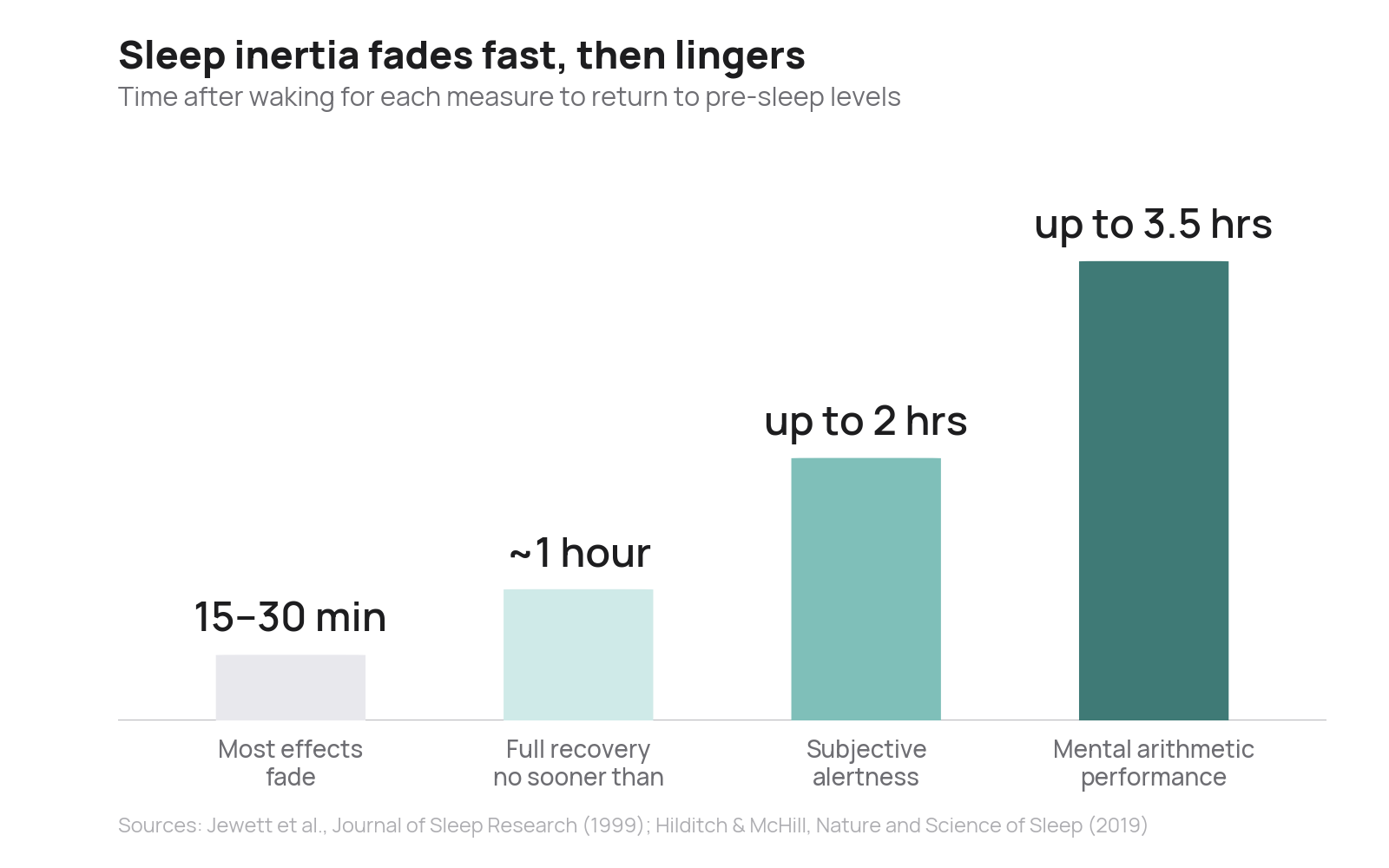
So the practical answer depends on what you're asking. Feeling human again: 15 to 30 minutes. Being genuinely back to full cognitive capacity: potentially a couple of hours or more, depending on the task and how you slept.
What makes sleep inertia worse?
Four factors reliably intensify it.
Sleep loss. Performance on waking is significantly worse after a night of restricted sleep than after a full one. Chronic restriction compounds this: in a study led by McHill and published in Sleep, people restricted to about 5.6 hours per day showed a 10% worsening of performance immediately on waking, and their average performance still hadn't returned to baseline 70 minutes later.
Waking during the biological night. Sleep inertia is worst near your circadian low, when core body temperature bottoms out in the early hours. Research by Scheer and colleagues found this circadian effect operates independently of the general effect of time of day on performance, which is bad news for anyone woken by a 3 a.m. call.
Waking from deep sleep, probably. This is the most commonly repeated explanation, and it's genuinely less settled than most articles suggest. Some studies support it strongly: Stampi reported a 41% reduction in performance when people woke from slow-wave sleep, while those woken from lighter Stage 2 sleep performed much like people who were already awake. But other research contradicts it, including a study by Lovato and colleagues in which participants showed no performance impairment despite 91% of them waking from slow-wave sleep. The 2019 review concluded it's difficult to draw a clear conclusion, noting the effect shows up mainly after longer naps and under high sleep pressure. So treat “you woke from deep sleep” as a plausible partial explanation, not a proven one.
Being a night owl. Research by Ritchie and colleagues found that people with later chronotypes took longer to recover from sleep inertia than earlier types.
Worth knowing: sleep inertia shows up even in well-rested people after a normal night's sleep at their usual time. These factors make it worse; none of them are required for it to happen.
Is sleep inertia dangerous?
It can be, in specific circumstances. The concern isn't the everyday experience of being slow over breakfast, it's performing safety-critical work in that window.
The most striking evidence comes from aviation. A retrospective analysis of more than 400 US Air Force accidents found that accidents attributed to pilot error were most common during the first hour after waking. Sleep inertia has also been cited as a contributing factor in commercial marine and aviation incidents that caused damage, injuries, and deaths, and surveys of night-shift nurses and emergency service pilots identify it as a recognized occupational problem.
The severity comparisons in the laboratory are equally sobering. In a study published in JAMA, Wertz and colleagues found that performance on an addition test immediately after waking was significantly more impaired than after an entire night without sleep. Research by Rosa and colleagues found that waking from two hours of recovery sleep after 64 hours of deprivation produced worse memory and reaction-time performance than before that recovery sleep. In another deprivation study, participants given 20-minute naps every six hours performed worse after waking than a group getting no sleep at all, and the inertia was so unpleasant that six of them withdrew from the study while every participant in the no-sleep group finished.
And here's the part that matters most practically: you are a poor judge of your own impairment during this window. Studies have found that subjective alertness and objective performance recover at different rates, with one finding no correlation between them at all. In one study, participants who had just taken a 30-minute nighttime nap rated their own performance as significantly better during the period when it was measurably worse. If you have to do something consequential right after waking, don't rely on feeling okay as evidence that you are.
How to reduce sleep inertia
Here the evidence is thinner than the internet suggests, so it's worth separating what works from what's merely popular. A dedicated review of reactive countermeasures, those you apply after waking, concluded there is currently no clear empirical evidence to fully support any of them for immediate, objective benefit.
What has the best support:
- Caffeine before a short nap. This is the standout. A study by Van Dongen and colleagues in Sleep found that caffeine consumed before a sleep opportunity eliminated psychomotor vigilance deficits from sleep inertia. The “coffee nap” is one of the few genuinely evidence-backed tactics here.
- Caffeine after waking, with limits. Even in fast-absorbing gum form, its effects are delayed. It may shorten the total duration but does nothing for the initial, most impaired period.
- Keep naps under 30 minutes. Inertia is less likely after short naps, probably because deep sleep typically takes around 30 minutes to begin. In one comparison, a 10-minute nap produced immediate performance improvements while a 30-minute nap produced none until 35 to 95 minutes later, depending on the task. That said, it isn't a guarantee; a 10-minute nap after extended wakefulness still produced impairment in one study.
- Sound and music, tentatively. Pink noise eliminated the sleep inertia effect after a one-hour nap in one study, and music people actually liked improved cognitive performance for up to 20 minutes after a short nap. Small studies, but promising, and easy to try.
- Light, mostly subjective. Two studies tested bright light after waking. One improved how alert people felt; neither improved objective performance.
- Temperature and exercise, unproven. Cooling the extremities is a plausible theory that hasn't been tested in an intervention study. Exercise has no studies at all, only reasonable speculation about blood flow.
The more reliable strategy is proactive planning: limit how long you're awake before sleeping, minimize both acute and chronic sleep debt, avoid scheduling wake-ups during the biological night when possible, and keep naps short. For rebuilding a consistent schedule, our guide on how to fix your sleep schedule covers the timing side in detail.
When sleep inertia is a sign of something else
Ordinary sleep inertia is universal and brief. Severe, prolonged inertia is not, and it has a name: sleep drunkenness, a prominent feature of idiopathic hypersomnia, in which people wake confused, repeatedly fall back asleep, and struggle for extended periods with significant impairment to daily functioning.
If you routinely need hours to become functional, sleep long and wake unrefreshed, or fall asleep unintentionally during the day, that's worth raising with a doctor rather than managing with more coffee. Our guides on oversleeping and narcolepsy cover the conditions that can present this way.
Frequently asked questions
How long does sleep inertia last?
Usually 15 to 30 minutes for the most noticeable effects, though full recovery generally takes at least an hour. In one controlled study, subjective alertness continued improving for up to two hours and performance on a mental arithmetic task took up to three and a half hours to fully normalize. Duration depends on how much you slept, when you woke, and how demanding the task is.
Is sleep inertia normal?
Yes. It's a universal part of the sleep-wake transition and has been observed even in well-rested people waking at their usual time after a full night's sleep. Sleep researchers treat it as a normal third process of sleep regulation. What isn't normal is severe grogginess lasting hours, which can indicate a sleep disorder.
What causes sleep inertia in the morning?
Your brain doesn't wake all at once. After waking, EEG still shows sleep-associated slow-wave activity, cerebral blood flow remains below waking levels for up to half an hour, and the prefrontal cortex is among the last regions to come fully back online. Leftover adenosine, the compound that builds sleep pressure, may also contribute.
Does coffee help with sleep inertia?
Yes, but the timing is counterintuitive. Caffeine taken before a short nap has been shown to eliminate the vigilance deficits of sleep inertia, which is why the “coffee nap” works. Caffeine taken after waking is absorbed too slowly to help during the worst initial period, though it may shorten the overall duration.
Why do I feel worse after a long nap than a short one?
Longer naps let you enter deep slow-wave sleep, which typically begins around 30 minutes in, and waking from that appears to produce heavier grogginess. In one study a 10-minute nap improved performance immediately while a 30-minute nap delivered no benefit for 35 to 95 minutes. Keeping naps under about 30 minutes is the usual advice, though it doesn't eliminate the risk entirely.
Sleep inertia is normal, temporary, and more impairing than it feels, which is the combination that makes it worth understanding. The practical takeaways are modest but real: keep naps short, have your coffee before the nap rather than after, protect your sleep so you're not compounding inertia with sleep debt, and be genuinely cautious about consequential decisions in the first hour after waking, especially since your own sense of being fine is unreliable in exactly that window.